The quiet restructuring of Spain's tech sector
Capgemini announces an ERE citing AI, banks are bringing tech teams in-house at full speed, and the bodyshopping model that employs 285,000 people is showing structural cracks. This is how Spain's tech sector is being restructured in 2026.
There's something I've been watching for months now, and I don't think it's being explained properly. Spain's tech sector is bringing in more revenue than ever, investment numbers around AI make headlines every week, but under the surface a deep restructuring is underway, and it's going to change the rules of the game for many of us.
Consulting firms are announcing EREs while explicitly citing AI, banks are bringing tech teams in-house at an unprecedented pace, startups are maturing but graduating out of the country, and the bodyshopping model that employs hundreds of thousands of people in Spain is showing structural cracks. I've pulled together data from IDC, AMETIC, Whitelane Research, McKinsey and the companies' own financial reports to understand what's really going on. In a second article I look at how this restructuring is splitting the tech job market and salaries in two.
A 62 billion euro market growing at two speeds
Spain's IT market reached 62.458 billion euros in 2025 according to IDC, with projected annual growth of 5.8% through 2028. AMETIC puts the broader digital economy at 138.205 billion, a record high representing 26% of GDP. The sector now employs more than 522,000 professionals in digital services, crossing the half-million mark for the first time.
But those headline figures lump together two diverging realities. Segments tied to artificial intelligence are growing at 42.4% per year, cybersecurity at 12.4%, and cloud at 10.2%. Meanwhile, traditional categories like IT outsourcing, conventional development, and application maintenance are showing modest single-digit growth. Mordor Intelligence projects the total ICT market will reach 92.620 billion dollars by 2030, but most of that growth will be concentrated in AI, cloud, and cybersecurity.
Spain holds a notably competitive position in Europe. It's the third-ranked country in connectivity (fiber in 94% of households, 5G covering 96% of the urban population) and sits among the top seven or eight in the European Commission's Digital Decade ranking. Hyperscalers are betting big, with AWS announcing 17.270 billion euros for a data center cluster in Aragón, and combined commitments from AWS, Microsoft and Oracle exceeding 22 billion dollars. Even so, R&D investment remains at 1.49% of GDP, well short of the 3% target, and only 2.9% of SMEs use AI, compared to 35% of large companies.
Public ICT investment fell by 26.2% in 2025 to 4.373 billion, tied to the execution cycles of European funds. That said, what the state isn't investing is more than offset by hyperscalers making multibillion-dollar infrastructure bets on Spanish soil.
Tech consulting faces its existential moment
Spain's tech consulting sector brought in 21.982 billion euros in 2024, up 8.8%, while employing 285,282 professionals. Behind those record numbers, a transformation is taking shape that threatens the dominant business model.
Capgemini España announced an ERE in April 2026, explicitly citing the impact of AI. It's the first major consulting firm in Spain to directly link layoffs to artificial intelligence. The company, with around 11,000 employees and 700 million in revenue in Spain, acknowledges a high number of employees "on the bench" (without an assigned project), which reflects a structural mismatch between its internal talent supply and actual demand for services. At the same time, Capgemini is carrying out 2,400 layoffs in France while distributing 1.552 billion euros in dividends and share buybacks globally.
The bodyshopping model, which accounts for 46.9% of the sector's revenue, is under pressure like never before. As Morningstar puts it, "AI-led efficiency gains in software development mean fewer billable hours under the time-and-materials model". Developers using AI tools produce two to three times more output, reducing the number of profiles needed per project. Only 14% of tech companies plan to increase headcount in the first quarter of 2026, down from 32% a year earlier.
Still, the sector isn't shrinking evenly, it's being reconfigured. Hiberus is growing more than 20% per year and aiming for 1 billion in revenue by 2030 with a model based on hyper-specialization and zero debt. It's Top 3 in client satisfaction and in AI/GenAI according to Whitelane Research 2025. Indra/Minsait reached 5.457 billion in group revenue (up 13%), driven by defense, which is growing 36%, while rolling out Microsoft Copilot across more than 3,000 internal positions. Accenture is investing 3 billion dollars in data and AI between 2023 and 2026 and acquired Keepler, a Spanish consulting firm specialized in data.
The consulting firms that survive will be the ones that move from the "bodies by the hour" model to a "results with AI uplift" model. The AEC (Asociación Española de Consultoría) talks about "augmented consulting", where professionals backed by AI tools deliver more value with fewer resources. Revenue from advanced technologies already makes up 32.8% of the sector total (7.200 billion), and 37% of training hours are now devoted to AI, big data, and cybersecurity.
Banks bring work in-house and cut dependence on consulting firms
Spanish banks have become European references in digital transformation, and their strategy of bringing tech teams in-house has direct implications for the consulting sector.
CaixaBank announced a 5 billion euro technology investment for 2025-2027 under its "Cosmos" plan, created the first AI Office in Spanish banking, and its tech subsidiary added 600 tech professionals in 2024, with plans to hire up to 3,000 young profiles. BBVA rolled out "The Eight", eight interconnected AI initiatives, and its AI Factory now has more than 400 dedicated professionals. It was the first European bank to partner with OpenAI, with 11,000 employees using ChatGPT Enterprise, more than 20,000 custom GPTs created, and time savings of 76% on certain tasks. Santander is aiming to generate more than 1 billion per year in business value from data and AI by 2028, with 6,000 in-house developers using AI tools that improve productivity by 20-30%.
The in-house shift is unmistakable. According to McKinsey, leading banks are moving away from large contractor teams with limited experience toward smaller, highly skilled internal teams. One textbook case shows a major bank going from 70% external staff to 70% internal in engineering in just three years. Banks are keeping strategic alliances with hyperscalers (AWS, Google Cloud, Azure, OpenAI) while reducing their dependence on traditional bodyshopping consultancies.
The fintech ecosystem complements this transformation. Spain now has more than 427 fintech entities (47% more than in 2020), and Bizum has reached 28.8 million users, accounting for more than 50% of the country's bank transfers. The cryptoassets vertical is the fastest-growing one, going from 8 entities in 2020 to 88 in 2025.
Startups that mature but graduate elsewhere
Spain's startup ecosystem reached an aggregate value of more than 110 billion euros for the first time, with 3.100 billion invested in 2025 across 376 rounds. The story here is selective maturation, not a broad-based explosion.
The 2025 success stories set some important milestones. TravelPerk (rebranded as "Perk") raised a 200 million dollar Series E at a 2.700 billion valuation, but moved its headquarters to Boston/London, showing a worrying pattern of Spanish startups that "graduate" out of the country as they scale. vLex was acquired by Clio for 1 billion dollars, the biggest deal in the history of global legaltech. HBX Group (Hotelbeds) led the biggest European IPO of early 2025 with 748 million euros raised. And Factorial hit 100 million ARR and is exploring a round that would double its valuation to 2 billion.
But the ecosystem also shows fragility. Wallbox, listed on NYSE, is under severe financial stress with only 9.6 million in cash against 165 million in debt. Glovo announced the formal employment of 15,000 riders with an estimated 100 million impact on EBITDA, and it has accumulated 400 million in litigation. And no new Spanish unicorn has emerged since 2023.
The most promising "soonicorns" include Civitatis (traveltech with more than 200 million in revenue), SeQura (BNPL), Exoticca (travel), Lingokids (edtech, with a round of more than 100 million), and Embat (treasury SaaS). In the AI space, Multiverse Computing raised 189 million euros in Series B for quantum-AI computing, the biggest Spanish round in the segment. Barcelona leads with 47% of the capital invested in startups, followed by a rising Valencia. The main structural bottleneck is still the jump from seed to Series A, with rates below the European average.
Regulation moves forward with bottlenecks
Spain is positioning itself as a European leader in digital governance. AESIA (Agencia Española de Supervisión de IA), operational since June 2024, was the EU's first AI oversight agency. It launched the first regulatory AI sandbox in April 2025, published 16 compliance guides, and the draft Spanish AI law is now going through parliament.
The Recovery Plan has mobilized 98.3% of the 79.854 billion in grants, with Spain leading the EU in disbursements received. Kit Digital distributed 3.067 billion euros through 858,000 grants for SME digitalization, the biggest program of its kind in Spanish history. Even so, 10.443 billion in R&D&I still remains to be executed before August 2026.
One date the whole sector should have on its calendar is August 2, 2026, when high-risk AI systems in financial services (credit scoring, anti-money laundering, risk assessment) will need to fully comply with the European AI Act, with penalties of up to 7% of global revenue. The Startup Law, in force since 2023, has already certified more than 2,800 companies with a reduced 15% corporate tax rate and tax exemption on stock options up to 50,000 euros per year, while the digital nomad visa is attracting international talent with a favorable 24% tax regime on the first 600.000€.
Spain's tech sector is bringing in more revenue than ever, but the way that growth is distributed is changing in a meaningful way. AI is growing at 42% per year while traditional outsourcing is showing signs of stagnation. Consulting firms most dependent on bodyshopping, banks that don't strengthen their internal capabilities, and startups that fail to secure funding to scale could face greater competitive pressure over the next few years. The restructuring has already started, and Capgemini's ERE can be read as an early warning sign.
Sources

Jose, author of the blog
QA Engineer. I write out loud about automation, AI and software architecture. If something here helped you, write to me and tell me about it.
Leave the first comment
What did you think? What would you add? Every comment sharpens the next post.
If you liked this
La IA está partiendo el mercado laboral tech español en dos
El 90% de los developers usa IA a diario pero solo el 16% recibe formación. Un senior backend gana 35.000€ en consultora o 130.000€ en Big Tech remoto. Manfred lo llama la mayor brecha salarial de la historia del tech español.

ScamDetector, un detector de estafas con inteligencia artificial
ScamDetector combina inteligencia artificial, búsqueda de reputación de teléfonos y escaneo de URLs para ayudarte a identificar estafas digitales. Sin registro, sin datos almacenados.
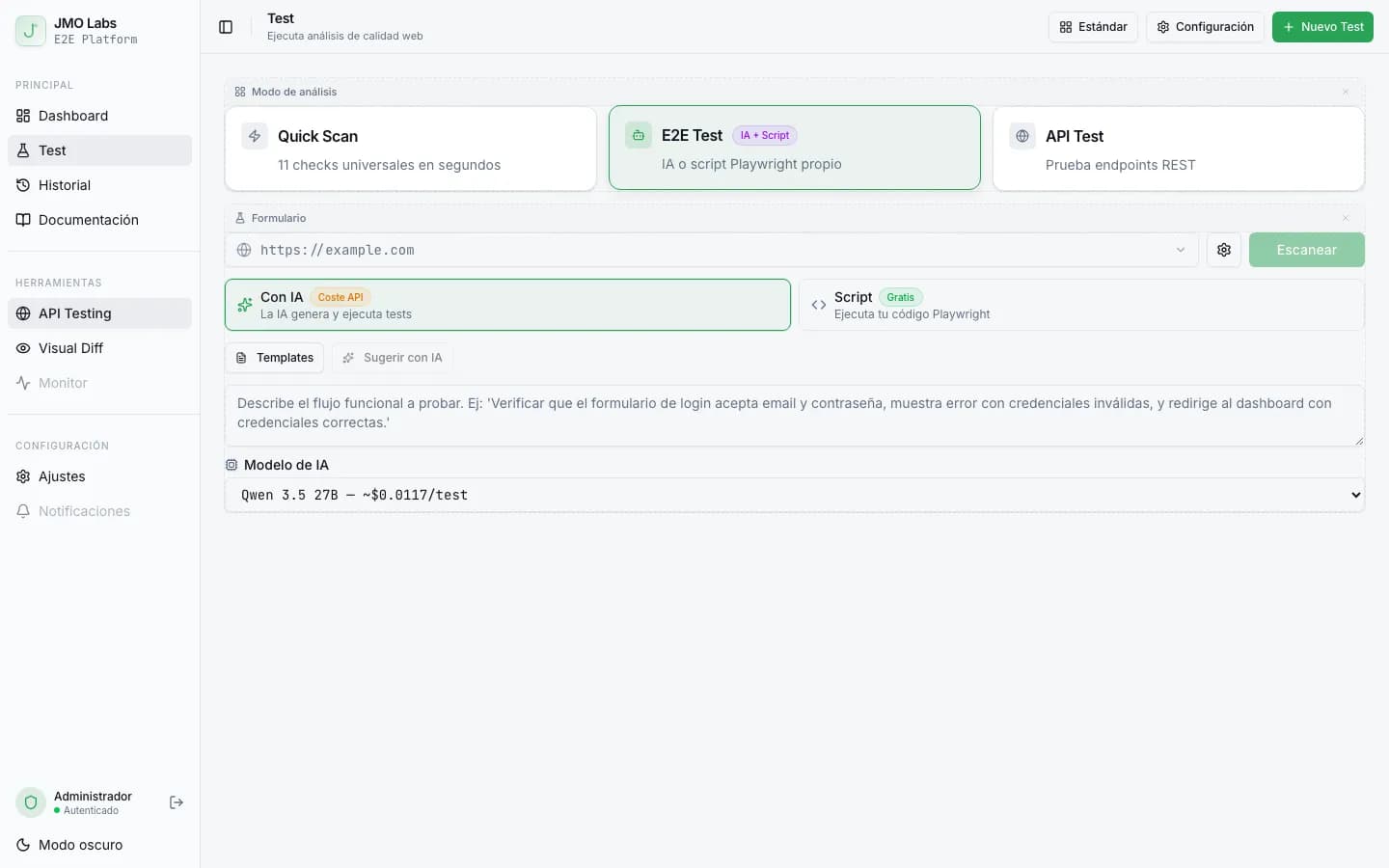
Tests E2E que se reparan solos: cómo construimos un pipeline de self-healing con IA
Los tests E2E se rompen con cada cambio de interfaz. En JMO Labs construimos un pipeline de 5 fases con IA que planifica, ejecuta, repara selectores, diagnostica fallos y verifica resultados de forma autónoma. La caché de selectores hace que cada ejecución sea más rápida que la anterior.