AI is splitting the Spanish tech job market in two
90% of developers use AI every day, but only 16% get training. A senior backend engineer makes €35,000 at a consulting firm or €130,000 working remotely for Big Tech. Manfred calls it the biggest pay gap in the history of Spanish tech.
Manfred's 2026 Salary Guide puts it plainly. "There has never been a pay gap this large between people with the same role and the same level of experience in tech." And it's right. AI isn't creating a better or worse job market, it's creating two markets that look less and less alike.
This is the second article in a two-part analysis. In the first one I look at how the Spanish tech sector is being restructured at the company and industry level. Here I'm focusing on what affects us most as professionals, which is which profiles have a future, which don't, and how salaries are moving.
The profiles AI is leaving behind
The most revealing figure in the Spanish tech job market is that 90% of developers in Spain already use AI tools every day, but only 16% have received formal training from their companies. That massive but messy adoption is creating an unprecedented gap between people who know how to use AI well and those who don't.
Job growth in digital services fell from 16.3% in 2022 to 2.1% in 2025, and Fundación VASS attributes part of that slowdown to the "lower pressure to hire juniors" caused by AI. Spain's Big Four cut hiring of people under 30 by 10 to 20%. Manual QA testers are facing a fast transformation, since IDC projects that by 2028, 80% of software tests will be generated by AI. The classic systems administrator role shows stagnant pay, while the SRE/DevOps profile holds medians of €58,500.
Randstad Research estimates that AI will create 1.61 million new jobs in Spain over the next decade, but destroy 2 million, with a net negative balance of around 400,000 jobs. The jobs that disappear will be concentrated in administrative roles, manual QA, junior development, and IT support.
The profiles that are booming
On the other side of the coin, AI-related profiles are seeing unprecedented demand. AI Engineer is the fastest-growing role in Spain according to LinkedIn's "Jobs on the Rise 2026", with 340% more openings than in 2024 and median salaries of €52,250 (75th percentile at €68,500). MLOps roles are especially scarce, with the 75th percentile at €80,000. And specialists in AI Governance are becoming more urgent because of the European AI Act coming into force.
Workers with AI skills make 25% more than their peers without them, according to PwC. And we're not just talking about data scientists or ML engineers. Any tech profile that brings AI into their workflow, whether that's a QA using AI to generate and maintain tests, a DevOps engineer automating with agents, or a frontend developer speeding up development with Copilot, benefits from that salary premium.
Salaries moving at two speeds
The tech pay structure in Spain in 2026 is what Manfred calls "trimodal". A Senior Backend Engineer makes €35,000 at a traditional consulting firm, between €50,000 and €65,000 at a startup or scaleup like Factorial or Cabify, or €100,000-€130,000 and up at a Big Tech company like Google or Amazon while working remotely from Spain. That difference of more than €100,000 for the same title reflects unprecedented fragmentation.
Perfiles en crecimiento salarial (5-10% anual)
───────────────────────────────────────────────
Data Scientist              mediana 55.400€
MLOps                       mediana 60.125€    P75 en 80.000€
AI Engineer                 mediana 52.250€    P75 en 68.500€
SRE / DevOps                mediana 58.500€

Perfiles estancados o en descenso
───────────────────────────────────────────────
Frontend Developer          descenso real en todos los percentiles
Mobile Developer            "el rol más golpeado de 2025" según Manfred
QA Tester (manual)          salarios declinantes
Administrador de sistemas   estancamiento salarial
Hays projects an average 6% salary increase in IT for 2026, the third-highest increase of any sector. Compared to Europe, Spain pays 25% less than Germany and the Netherlands, but the gap is narrowing since senior salary growth in Spain (4%) is higher than in the UK (0.3%) and the Netherlands (1.7%).
Adoption of AI tools in Spain
AI coding tools dominate the day-to-day work of Spanish developers. ChatGPT has 72% penetration, GitHub Copilot 50%, Claude 31.8%, and Gemini 29.9%. Copilot already generates 46% of the code written by its users and has passed 20 million global users. Cursor crossed $2 billion in annual revenue at the start of 2026.
Still, fewer than half of Spanish companies (48%) pay for AI tool licenses for all their employees. 25% of developers use personal paid accounts, which creates the odd situation where professionals are paying out of pocket for productivity because their companies aren't.
One worrying figure for people starting out in the industry. A Harvard study of 187,000 developers found that Copilot increases coding time by 12.4% but reduces collaborative interactions between coworkers by 80%. Senior engineers are the ones who get the most out of parallel AI agents. As Gergely Orosz puts it, "the only people I've seen use parallel agents successfully are senior+ engineers". This amplifies the advantage of experience and lowers the value of conventional junior work.
Remote work, emigration, and the talent war
Remote work has stabilized, but it hasn't disappeared. 68% of IT job openings include a remote option, although fully remote listings fell from 21% in 2021 to 11% in 2025. Manfred identifies a "presential premium" of 20%, which means companies that require full in-office presence have to pay significantly more to attract the same talent.
Spain has more than three million citizens living abroad, 40% of Spaniards are considering emigrating, and 60.9% cite salary as the main reason. Paradoxically, the country needs 200,000 new engineers over the next decade while 120,400 tech openings remain unfilled. The talent drain speeds up when the gap with the international market is this stark, and neither the Startup Law nor the digital nomad visa are managing to offset it.
What to do with all this
If you ask me what I'd do with this data, the answer is simple. AI is not optional. It doesn't matter whether you're in QA, development, DevOps, or data. That 25% salary premium for AI skills isn't a fad, it's the market telling you where the value is. And with only 16% of professionals getting formal training, anyone who invests on their own to really learn how to use these tools has a huge competitive advantage.
The other message that seems important to me is the "trimodal" salary structure. If you're at a traditional consulting firm making €35,000 as a senior, it's not that you're being paid badly "for the market". It's that you're in a submarket with its own rules. The exact same profile is worth two or three times as much in another context. Making that jump isn't necessarily easy, but it's worth knowing that it exists.
There has never been a gap this large inside the tech sector between people who know how to use AI and those who don't. And what worries me isn't the gap itself, but how fast it's widening. Every quarter you spend without bringing AI into your workflow is another quarter of distance between you and the people who already have.
Sources

Jose, author of the blog
QA Engineer. I write out loud about automation, AI and software architecture. If something here helped you, write to me and tell me about it.
Leave the first comment
What did you think? What would you add? Every comment sharpens the next post.
If you liked this
La reestructuración silenciosa del sector tech en España
Capgemini anuncia un ERE citando la IA, los bancos internalizan equipos tech a marchas forzadas y el bodyshopping que emplea a 285.000 personas muestra grietas estructurales. Así se está reestructurando el sector tecnológico español en 2026.

ScamDetector, un detector de estafas con inteligencia artificial
ScamDetector combina inteligencia artificial, búsqueda de reputación de teléfonos y escaneo de URLs para ayudarte a identificar estafas digitales. Sin registro, sin datos almacenados.
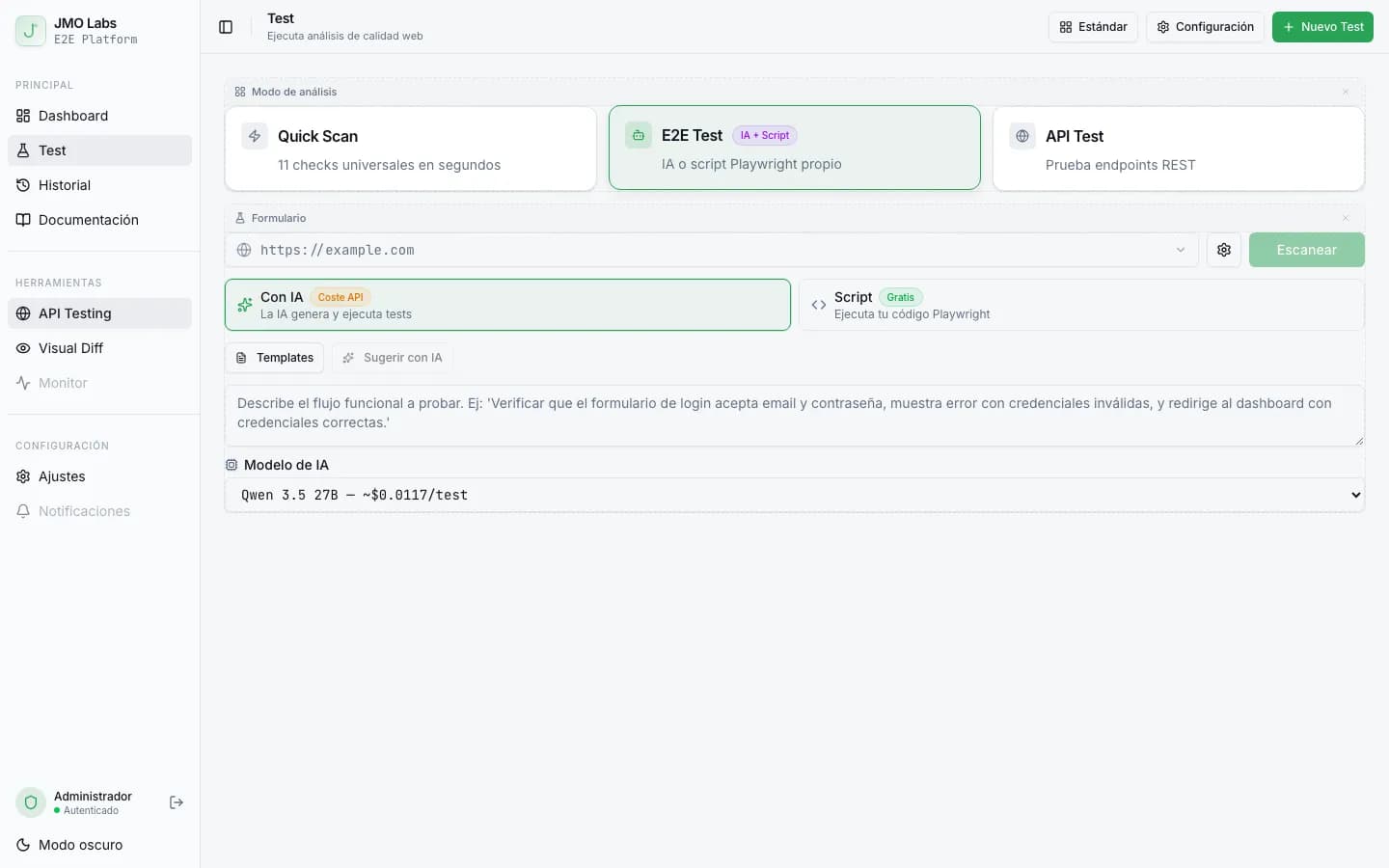
Tests E2E que se reparan solos: cómo construimos un pipeline de self-healing con IA
Los tests E2E se rompen con cada cambio de interfaz. En JMO Labs construimos un pipeline de 5 fases con IA que planifica, ejecuta, repara selectores, diagnostica fallos y verifica resultados de forma autónoma. La caché de selectores hace que cada ejecución sea más rápida que la anterior.