Environment variables in E2E scripts: safe secrets in JMO Labs
E2E scripts need sensitive data, API tokens, credentials, private URLs, without showing up in the code. In JMO Labs we've added script variables with private mode: they're injected automatically, masked in logs, and accessed with a clean syntax.
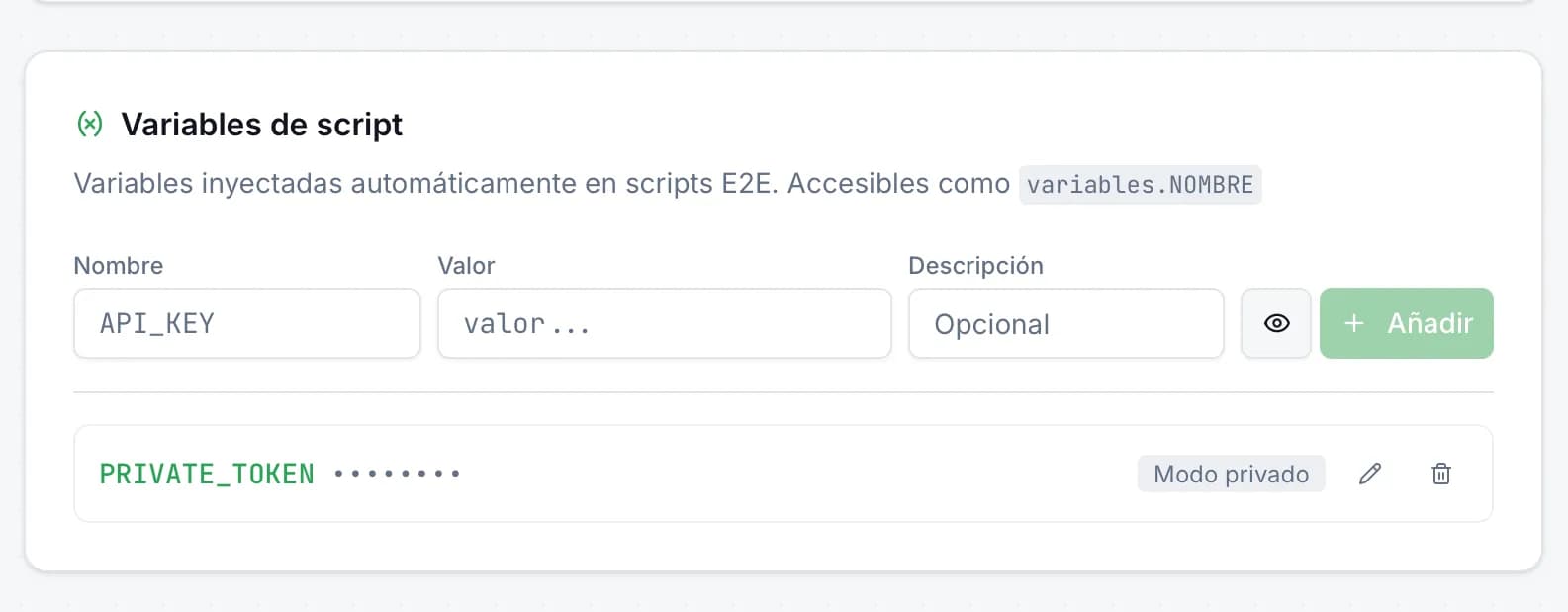
When you write E2E scripts that interact with real applications, sooner or later you need data that shouldn't live in the code: API tokens, login credentials, URLs for private environments. Hardcoding these values is a security risk and a maintenance problem. At JMO Labs we solved this with script variables.
What script variables are
Script variables are key-value pairs that you define once in the JMO Labs configuration and that get injected automatically into every E2E script run. You access them with the variables.NOMBRE syntax, with no imports or extra configuration in the script. If you're interested in the solution we adopted, we explain it in detail in secret management with Infisical.
Each variable has three fields:
The name, an identifier in
SCREAMING_SNAKE_CASEformat (for example,API_KEY,PRIVATE_TOKEN).The value, the data that will be injected into the script.
An optional description that documents what the variable is for.

Private mode: protecting sensitive data
Not all variables are the same. A BASE_URL can show up in logs without any problem, but a PRIVATE_TOKEN shouldn't be visible anywhere. That's what private mode is for.
When a variable is marked as private:
Its value is shown masked (
••••••••) in the admin interface.It's automatically redacted in console output and execution logs.
It's still accessible normally inside the script through
variables.NOMBRE.

The interface clearly shows which variables are in private mode with a visual label, and the edit and delete controls are always accessible.
How they're used in an E2E script
Inside a script, variables are available as properties on a variables object that gets injected automatically into the execution sandbox. The object is read-only (Object.freeze) to avoid accidental changes.
Let's look at a real example: a private mode test that needs a token to enable a protected feature.

The script checks whether variables.PRIVATE_TOKEN is defined. If it isn't, the test skips the activation part. If it exists, it uses it to navigate to the private mode activation URL:

The important part is that the token never appears in the script, because it's passed from the API through the injected variables. If someone reviews the test code, they won't see credentials. If they check the execution logs, the value shows up redacted.
Technical implementation details
Under the hood, variables are managed with these constraints:
Maximum of 100 variables per instance.
Each value can be up to 10 KB.
Names must follow the
[A-Z][A-Z0-9_]{0,63}pattern, uppercase letters, numbers, and underscores only.The variables are inserted into the Node.js sandbox VM as a frozen, immutable object.
Secret variable values are intercepted in standard output and replaced with
[REDACTED].
The API endpoint (/api/script-variables) allows full CRUD operations, with strict validation of the name format and a secret flag that controls masking.
Why this matters
In E2E testing, secret management is usually a blind spot. Teams end up with tokens in .env files shared over Slack, credentials hardcoded in test scripts, or CI/CD variables that aren't accessible when someone runs the tests locally.
Script variables in JMO Labs solve this with a centralized approach: you define them once in the platform, they're available in every script, and sensitive ones are never exposed in the interface or in the logs. Simple, safe, no friction. If you want to go deeper, we cover it in detail in Playwright as the testing engine in JMO Labs.

Jose, author of the blog
QA Engineer. I write out loud about automation, AI and software architecture. If something here helped you, write to me and tell me about it.
Leave the first comment
What did you think? What would you add? Every comment sharpens the next post.
If you liked this

La paradoja del pesticida, el quinto principio del testing que ignora tu equipo
Es el quinto principio del testing, y el que más equipos pasan por alto. Ejecutar los mismos tests una y otra vez acaba siendo un placebo caro.
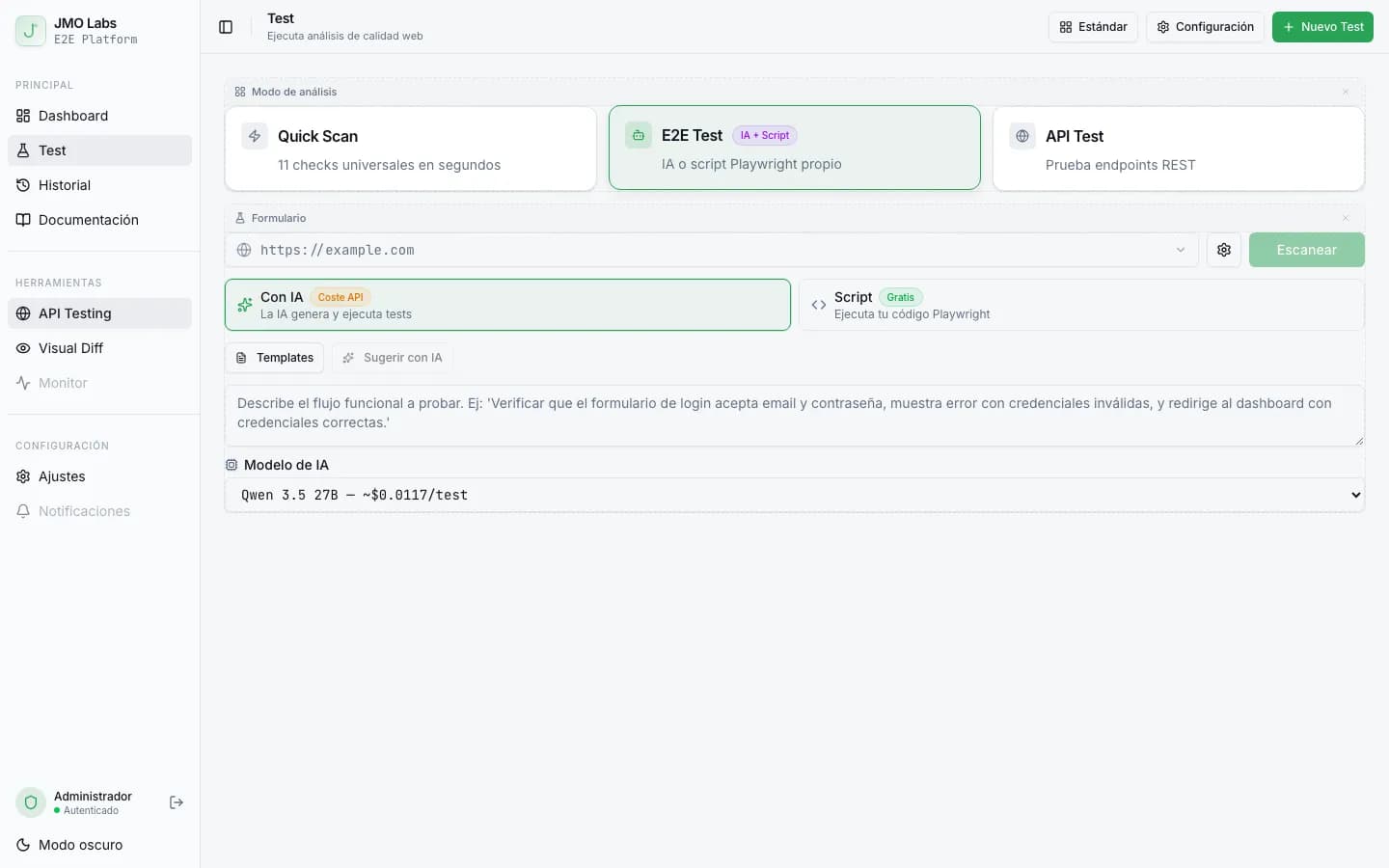
Tests E2E que se reparan solos: cómo construimos un pipeline de self-healing con IA
Los tests E2E se rompen con cada cambio de interfaz. En JMO Labs construimos un pipeline de 5 fases con IA que planifica, ejecuta, repara selectores, diagnostica fallos y verifica resultados de forma autónoma. La caché de selectores hace que cada ejecución sea más rápida que la anterior.
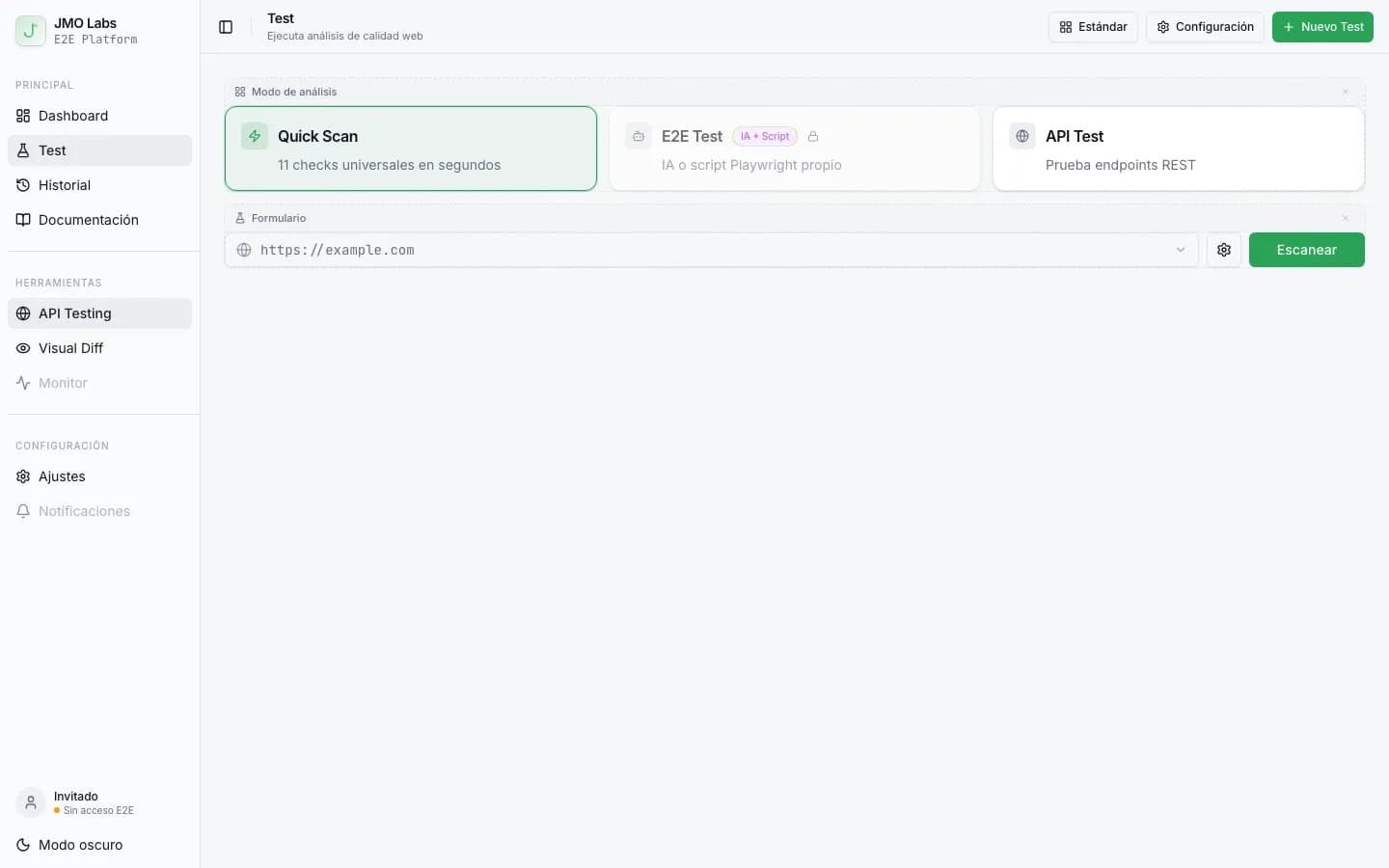
Construir una plataforma de testing con Playwright: arquitectura de JMO Labs
Playwright no es solo para tests E2E. En JMO Labs lo usamos como motor completo: 9 fases de comprobación, localizador de 9 estrategias con self-healing, grabación de vídeo, testing responsive con viewports reales y accesibilidad con axe-core.